
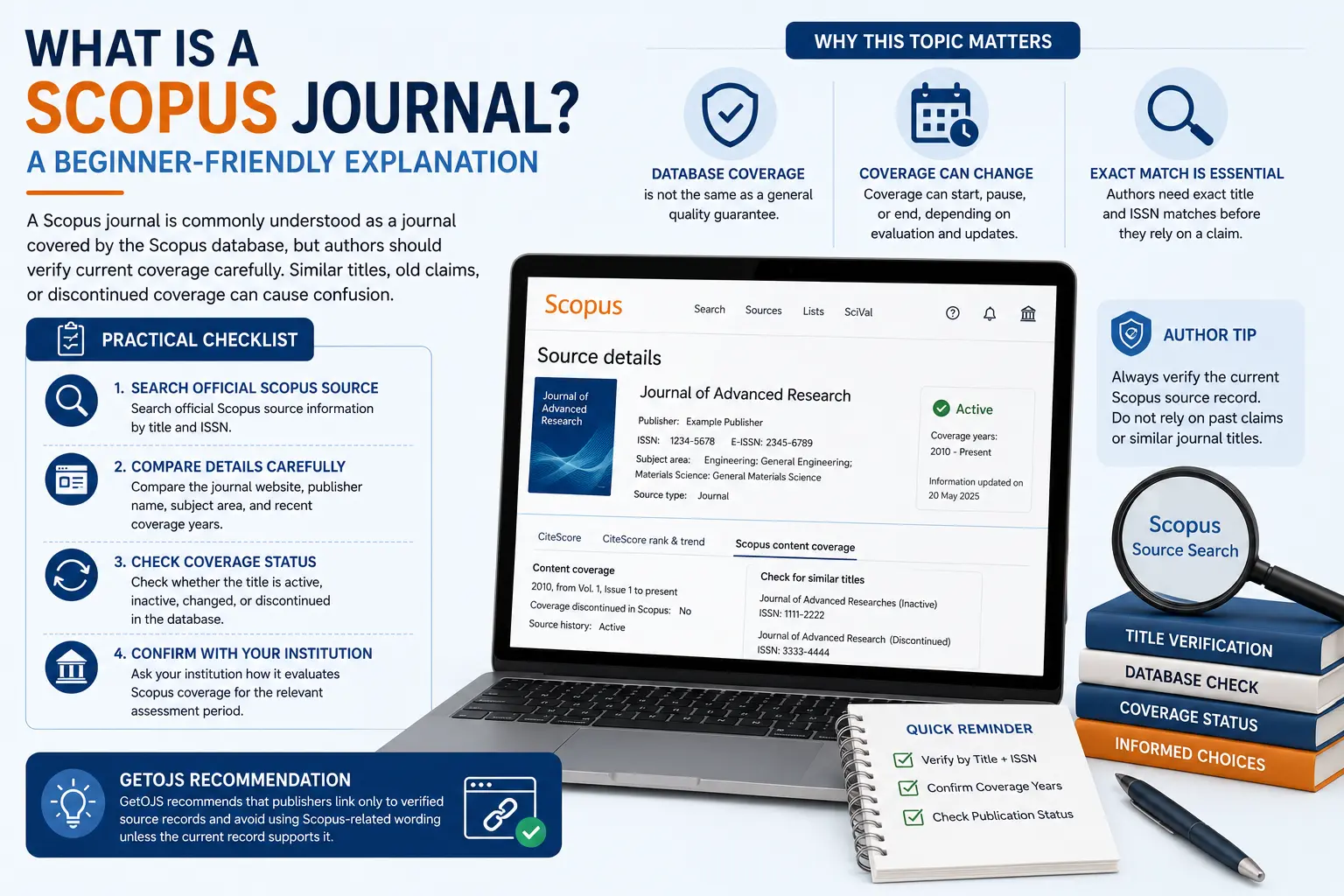
A Scopus journal is commonly understood as a journal whose content is covered by the Scopus database. For many beginners, this sounds simple, but in practice authors should understand what Scopus coverage means, how to verify a journal, why ISSN matching is important, and how discontinued or similar journal titles can create confusion.
What Is a Scopus Journal?
A Scopus journal is a scholarly journal that is included in Scopus, a large abstracting and citation database used by universities, researchers, librarians, funding agencies, and academic evaluation bodies. When a journal is covered in Scopus, its article records may appear in the database with bibliographic details such as article title, author names, abstract, keywords, affiliation, source title, volume, issue, page numbers, DOI, and citation information.
However, it is important to understand that the phrase “Scopus journal” does not automatically mean that every article on a journal website is currently indexed, that the journal will remain indexed forever, or that a journal is suitable for every academic requirement. Scopus coverage is based on source records, subject areas, coverage years, evaluation status, and ongoing database updates. Authors should always verify the current source information before submitting a paper.
Why Authors Search for Scopus Indexed Journals
Many authors look for Scopus indexed journals because Scopus coverage is often considered valuable in academic promotions, Ph.D. requirements, institutional evaluation, funding applications, and research visibility. A paper published in a journal that is properly covered by a recognized database may be easier to discover, cite, and track. For early-career researchers, publishing in a suitable indexed journal can support academic growth and help build a stronger research profile.
At the same time, indexing should not be the only reason to choose a journal. Authors should also check the journal scope, peer review process, editorial board, publication ethics, author guidelines, article processing charges, review timeline, indexing claims, publisher credibility, and previous published issues. A journal must match the subject and quality of your research, not only your indexing target.
Scopus Coverage Is Not the Same as a Quality Guarantee
- Scopus coverage shows that a source has been selected for database inclusion, but authors still need to evaluate the journal carefully.
- Coverage can change over time depending on database review, publication practices, title changes, and other editorial factors.
- A journal may have old Scopus records but may not be currently active or may have discontinued coverage.
- Some websites may use confusing claims, similar titles, or outdated screenshots, so official source verification is essential.
How Scopus Journal Verification Works
The safest way to verify a Scopus journal is to check official source information using the exact journal title and ISSN. ISSN numbers are especially important because many journals have similar names, and some titles may have separate print ISSN and electronic ISSN. A small difference in title, publisher name, or ISSN can indicate that you are looking at a different source.
When checking a journal, compare the journal title, ISSN, publisher, subject area, source type, coverage years, and current status. Also compare the journal website listed in official records with the website where you plan to submit. If the website looks different, has spelling errors, uses a suspicious domain, or makes unrealistic publication promises, investigate carefully before paying any fee or uploading your manuscript.
Practical Checklist Before Choosing a Scopus Journal
- Search the official source record using the exact journal title and ISSN.
- Confirm whether the title is active, inactive, changed, transferred, or discontinued.
- Check recent coverage years and whether current issues are appearing in the database.
- Compare the publisher name and journal website with the official source information.
- Review the journal’s aims, scope, author guidelines, peer review model, and publication ethics.
- Ask your institution how it evaluates Scopus coverage for your required academic period.
Understanding Active, Inactive, and Discontinued Titles
One of the most common mistakes made by new authors is assuming that a journal is Scopus indexed forever. Database coverage can change. Some journals may be active in the database, some may have coverage only up to a certain year, and some may have been discontinued. If a title has discontinued coverage, articles published after the discontinued period may not be treated the same way by institutions or databases.
This is why authors should avoid relying only on promotional statements such as “Scopus indexed journal” or “UGC approved Scopus journal” without checking official records. A claim may be old, incomplete, or misleading. Before submission, authors should confirm whether the journal’s current publication years are covered and whether the article type they are submitting is within the journal’s accepted scope.
Why ISSN Matching Is So Important
An ISSN is a unique identifier for a serial publication. Many journals have similar or nearly identical titles, especially in broad fields like engineering, management, education, medicine, and multidisciplinary research. Without checking ISSN, an author may confuse one journal with another. This can lead to submission to the wrong journal, payment to an unrelated publisher, or reliance on a false indexing claim.
Always compare both print ISSN and e-ISSN when available. Also check whether the journal website displays the same ISSN as the source record. If the website uses a different ISSN, does not show an ISSN, or shows an ISSN that belongs to another journal, treat it as a warning sign and verify further.
Common Red Flags Authors Should Avoid
- Guaranteed publication within a few days without proper peer review.
- Indexing claims without links to official source records.
- Very broad scope with no clear editorial board or review policy.
- Fake impact factor claims or confusing metrics not recognized by the institution.
- Website title, ISSN, and publisher details that do not match official records.
- Poorly written author guidelines, copied policies, or missing publication ethics information.
How Publishers Can Present Scopus Information Responsibly
Journal publishers should be careful when using Scopus-related wording on their websites. If a journal is currently covered, the website should provide accurate source information, correct ISSN details, and a clear explanation of coverage. Publishers should avoid exaggerated claims, outdated screenshots, or wording that suggests guaranteed indexing for every future article.
Responsible indexing pages should include the journal title, ISSN, publisher name, source link where applicable, indexing status, and the date on which the information was last reviewed. If coverage changes, the journal website should be updated quickly. Transparent communication protects authors, improves publisher credibility, and reduces disputes after publication.
How Open Journal Systems (OJS) Helps Journals Improve Indexing Readiness
Open Journal Systems (OJS) can help journals maintain structured publishing workflows that support indexing readiness. A properly configured OJS journal can display clear journal policies, editorial board information, issue archives, article metadata, author guidelines, DOI details, ORCID information, and stable article pages. These elements improve transparency and help indexing services understand the journal’s publishing structure.
For journals seeking broader visibility, OJS also supports consistent metadata entry, article galley management, publication scheduling, and long-term archive organization. Clean metadata is especially important because indexing databases depend on accurate titles, abstracts, keywords, author affiliations, references, and publication dates.
Tips for Authors Before Submitting to Any Scopus Claimed Journal
Before submitting your manuscript, prepare a small verification file for your own records. Save the official source record screenshot or link, journal website URL, ISSN details, author guidelines, APC details, and communication emails. This documentation can help if your institution later asks for proof of indexing or if you need to confirm the journal’s status at the time of submission.
Also read a few recently published articles in the journal. Check whether the articles are relevant, well formatted, properly referenced, and aligned with your subject area. If the published content looks unrelated or low quality, reconsider the submission even if the journal claims indexing.
GetOJS Recommendation
GetOJS recommends that authors and publishers treat Scopus verification as a careful checking process, not a one-line claim. Authors should verify title, ISSN, publisher, coverage years, journal website, and current status before submission. Publishers should display indexing information responsibly and keep journal websites transparent, updated, and standards compliant.
Need help improving your journal website?
Our team can help configure, migrate, secure, customize, or maintain your OJS journal website with clean metadata, indexing-ready structure, DOI support, and professional publishing workflows.
Frequently Asked Questions
Is every Scopus journal good for publication?
No. Scopus coverage is useful, but authors should still check journal scope, peer review, ethics, publisher credibility, article quality, APC transparency, and current coverage status.
How do I know whether a journal is really indexed in Scopus?
Check official source information using the exact journal title and ISSN. Do not rely only on screenshots, old lists, social media posts, or promotional claims.
Can a Scopus journal be discontinued?
Yes. Coverage can change over time. A journal may have records for older years but may not have current coverage, so authors should verify recent coverage before submission.
Why is ISSN important for Scopus verification?
ISSN helps identify the exact journal. Similar journal titles can confuse authors, so matching the correct print ISSN or e-ISSN is essential.
Can OJS help a journal become more indexing ready?
Yes. OJS helps organize editorial workflow, article metadata, issue archives, DOI details, author guidelines, and journal policies, all of which support professional publishing and indexing readiness.