
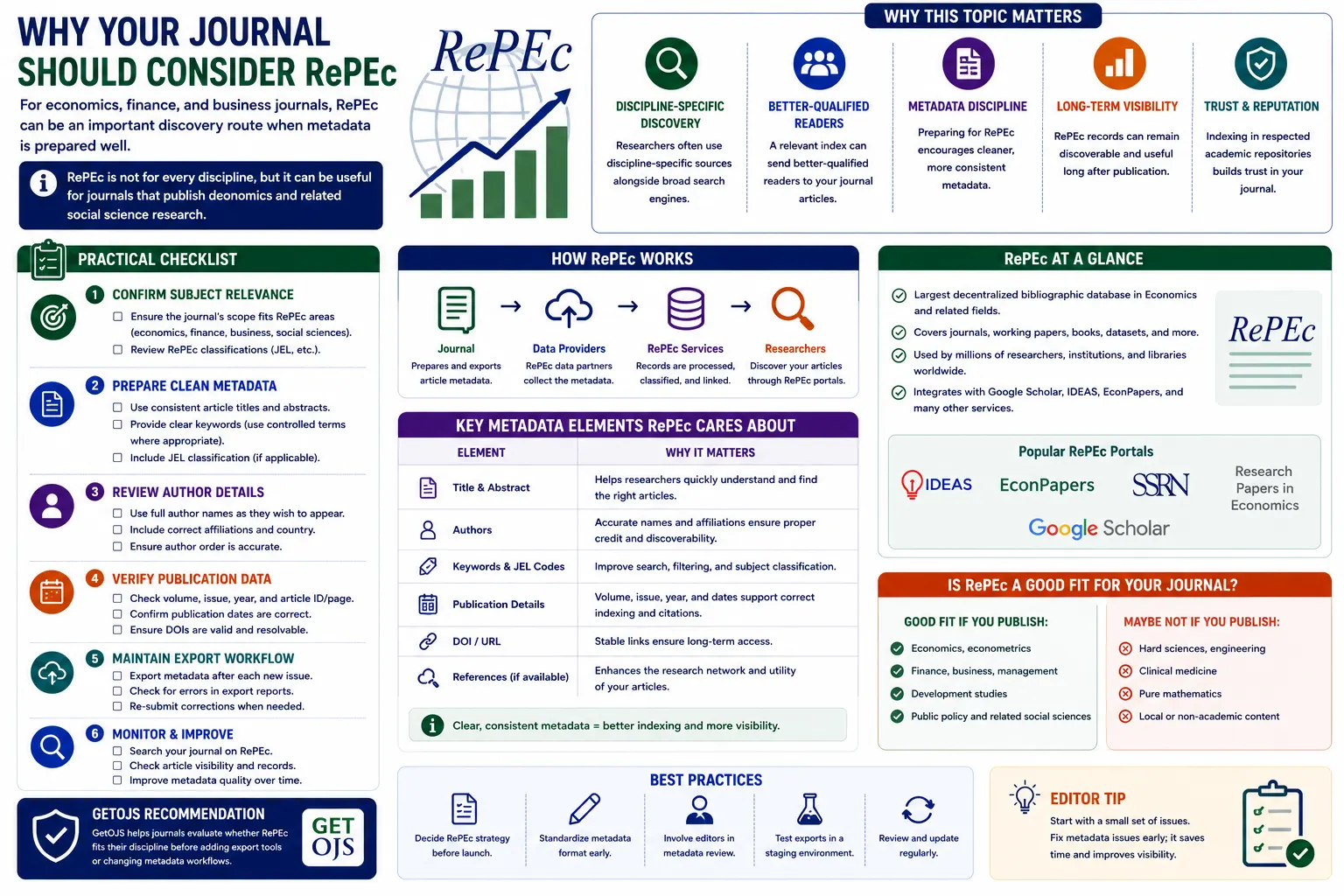
RePEc is not for every discipline, but it can be very useful for journals that publish economics, finance, business, management, public policy, development studies, econometrics, and related social science research. Many journals focus only on broad search engines and general indexing platforms, but discipline-specific discovery sources can also bring highly relevant readers to published articles. For the right journal, RePEc can become an important part of the journal’s visibility and metadata strategy.
What Is RePEc?
RePEc stands for Research Papers in Economics. It is a collaborative bibliographic database focused mainly on economics and related disciplines. It helps researchers discover working papers, journal articles, books, chapters, software components, and other academic outputs. For journals in economics, finance, business, and policy-related areas, RePEc can provide a subject-focused discovery channel where the audience is already interested in similar research.
Unlike a general search engine, RePEc is built around academic metadata. This means that article title, author names, abstract, keywords, publication date, journal name, issue details, and links matter a lot. If the metadata is incomplete or inconsistent, the value of RePEc exposure becomes weaker. A journal should therefore treat RePEc not only as a listing opportunity, but also as a reason to improve metadata discipline.
Why RePEc Matters for Suitable Journals
Researchers do not search for academic work in only one place. They may use Google Scholar, institutional repositories, indexing databases, library portals, publisher websites, DOI links, and discipline-specific platforms. For economics and related fields, RePEc can be one of those useful discovery routes. A journal that publishes relevant content can benefit from appearing where researchers already look for subject-specific material.
RePEc can also improve the journal’s professional presentation. When metadata is structured properly and maintained consistently, articles become easier to find, cite, and connect with author profiles. This is especially helpful for journals that want stronger visibility among economists, finance researchers, policy analysts, development researchers, and business scholars.
Which Journals Should Consider RePEc?
RePEc is most relevant for journals that publish in economics and closely connected areas. A pure medical, chemistry, engineering, or literature journal may not benefit much from RePEc because the audience and subject scope may not match. However, journals that publish economics, finance, econometrics, management, business studies, public policy, international trade, development studies, banking, accounting, entrepreneurship, and economic history may find RePEc useful.
- Economics and applied economics journals.
- Finance, banking, accounting, and investment research journals.
- Business, management, entrepreneurship, and marketing journals.
- Public policy, development studies, and trade-related journals.
- Interdisciplinary journals with a strong economics or policy component.
Benefit 1: Better Subject-Specific Discovery
The biggest reason to consider RePEc is subject-specific discovery. A journal may already appear in Google results, but broad search visibility does not always bring the most relevant academic audience. RePEc users are more likely to be searching for economics and related research. This makes the audience more focused.
For authors, this matters because they want their work to reach the right readers. For journals, this matters because stronger article discovery can improve readership, citations, submissions, and academic reputation over time. RePEc is not a shortcut to reputation, but it can support visibility when the journal’s subject area matches.
Benefit 2: Stronger Metadata Discipline
Preparing for RePEc often forces journals to review their metadata quality. This is a good thing. A journal should have clean titles, consistent author names, correct abstracts, useful keywords, proper issue details, publication dates, article URLs, and PDF links. If this information is messy, any indexing or discovery effort becomes weaker.
Metadata discipline helps beyond RePEc. The same clean metadata can support DOI deposits, search engine visibility, library discovery, citation tools, journal archives, and indexing applications. In this way, preparing for RePEc can improve the journal’s overall publishing quality.
Benefit 3: Better Visibility for Authors
Authors often choose journals based on reach, visibility, indexing, and academic trust. If a journal is discoverable through relevant academic channels, authors may feel more confident submitting their research. For economics and finance authors, visibility in a subject-specific database can be valuable.
RePEc can also help connect articles with broader academic discovery workflows. When article metadata is visible in discipline-relevant systems, readers can find the work more easily. This can support long-term author satisfaction and improve the journal’s appeal to future contributors.
Benefit 4: Support for Journal Reputation Building
RePEc alone does not make a journal high quality. A journal still needs peer review, editorial transparency, ethical publishing practices, strong metadata, regular publication, and clear policies. However, being present in appropriate discovery systems can support reputation building when combined with good publishing practices.
For new or developing journals in economics and business fields, RePEc can be one part of a larger visibility plan. That plan may also include DOI registration, ORCID integration, Google Scholar visibility, indexing readiness, clear editorial board information, author guidelines, publication ethics, and consistent issue publication.
Important Metadata Fields for RePEc Preparation
Before considering RePEc, journal teams should review whether their article metadata is complete and consistent. Missing metadata can reduce discoverability and create confusion. The editorial and production team should check article-level information carefully before export or listing.
- Journal title, ISSN, publisher name, and journal URL.
- Article title, abstract, keywords, and subject area.
- Author names, affiliations, and author identifiers where available.
- Volume, issue, year, page numbers, article number, or elocation ID.
- DOI, article landing page URL, and PDF URL.
- Publication date and issue assignment.
How OJS Helps with RePEc Preparation
Open Journal Systems already stores many useful metadata fields. Article titles, abstracts, keywords, authors, affiliations, issue data, publication dates, galleys, and DOI fields can be managed inside OJS. This makes OJS a strong base for preparing structured exports and maintaining article records.
However, OJS will only be as strong as the data entered into it. If authors submit incomplete metadata and editors publish without review, the final records may still be weak. Editors should check metadata during production, not after publication only. A clean OJS workflow makes RePEc preparation easier.
RePEc Export Workflow
A RePEc export workflow should be planned, not handled randomly. The journal should decide who is responsible for metadata review, when export files will be updated, how new articles will be included, and how corrections will be handled. If the journal publishes new issues regularly, RePEc maintenance should become part of the issue publication checklist.
For example, after a new issue is published, the team can review article metadata, confirm PDF links, verify DOI links, generate or update the export, and then check whether the new records appear correctly. This routine keeps the listing current and reduces the chance of outdated records.
Common Mistakes Journals Should Avoid
- Trying to use RePEc for a journal outside the relevant subject area.
- Exporting incomplete metadata with missing abstracts or author details.
- Using inconsistent author name formats across articles.
- Forgetting to update records after publishing a new issue.
- Providing broken article URLs or PDF links.
- Changing article URLs without redirect planning.
RePEc Is Not a Replacement for Other Indexing Work
RePEc should be understood as one part of a wider indexing and discovery plan. It does not replace DOI registration, search engine optimization, Google Scholar visibility, library indexing, institutional repositories, or other academic databases. Instead, it supports a specific subject-focused discovery route.
Journals should avoid presenting RePEc as if it were the same as Scopus, Web of Science, or other selective citation databases. Each platform has its own purpose, scope, and evaluation process. Clear communication helps authors understand what the journal actually offers.
How RePEc Can Support OJS Journals
For OJS journals, RePEc can support visibility when the journal already has good metadata, stable article pages, and consistent publishing practices. Since OJS provides article landing pages and structured metadata fields, it can become a useful base for RePEc preparation. The key is to ensure that exported information matches the public article page.
The article title, author list, publication date, DOI, and PDF link should be the same across the OJS website, PDF, citation text, and export record. Consistency improves trust and reduces correction work later.
When RePEc May Not Be the Right Fit
Not every journal should invest time in RePEc. If the journal does not publish economics, finance, business, management, policy, or related social science content, the value may be limited. A journal should first confirm whether its subject area matches the expectations of RePEc users.
If the journal is multidisciplinary, review the actual article categories. If only a small number of articles relate to economics, RePEc may not be the strongest discovery route. The journal may need a broader indexing strategy instead.
Practical Checklist Before Considering RePEc
- Confirm that the journal publishes economics or closely related research.
- Review journal title, ISSN, publisher details, and website URL.
- Check article titles, abstracts, keywords, author names, and affiliations.
- Verify DOI, article landing page URLs, and PDF links.
- Keep volume, issue, page number, article number, or elocation ID consistent.
- Prepare a repeatable export workflow after every issue publication.
- Assign one responsible person to review and maintain metadata quality.
GetOJS Recommendation
GetOJS recommends that journals first evaluate subject fit before adding RePEc export tools or changing metadata workflows. If the journal publishes economics, finance, business, management, or related policy research, RePEc may be a useful discovery route. If the subject fit is weak, the journal may be better served by other indexing and visibility strategies.
For suitable journals, RePEc preparation should be handled carefully. Clean metadata, stable URLs, correct PDF links, consistent issue details, and regular updates are essential. When managed properly, RePEc can help a journal reach a more focused academic audience and strengthen its long-term discovery plan.
Need help preparing your OJS journal for RePEc?
Our team can help review subject fit, clean metadata, configure export workflow, check article URLs, and improve indexing readiness for your OJS journal website.