
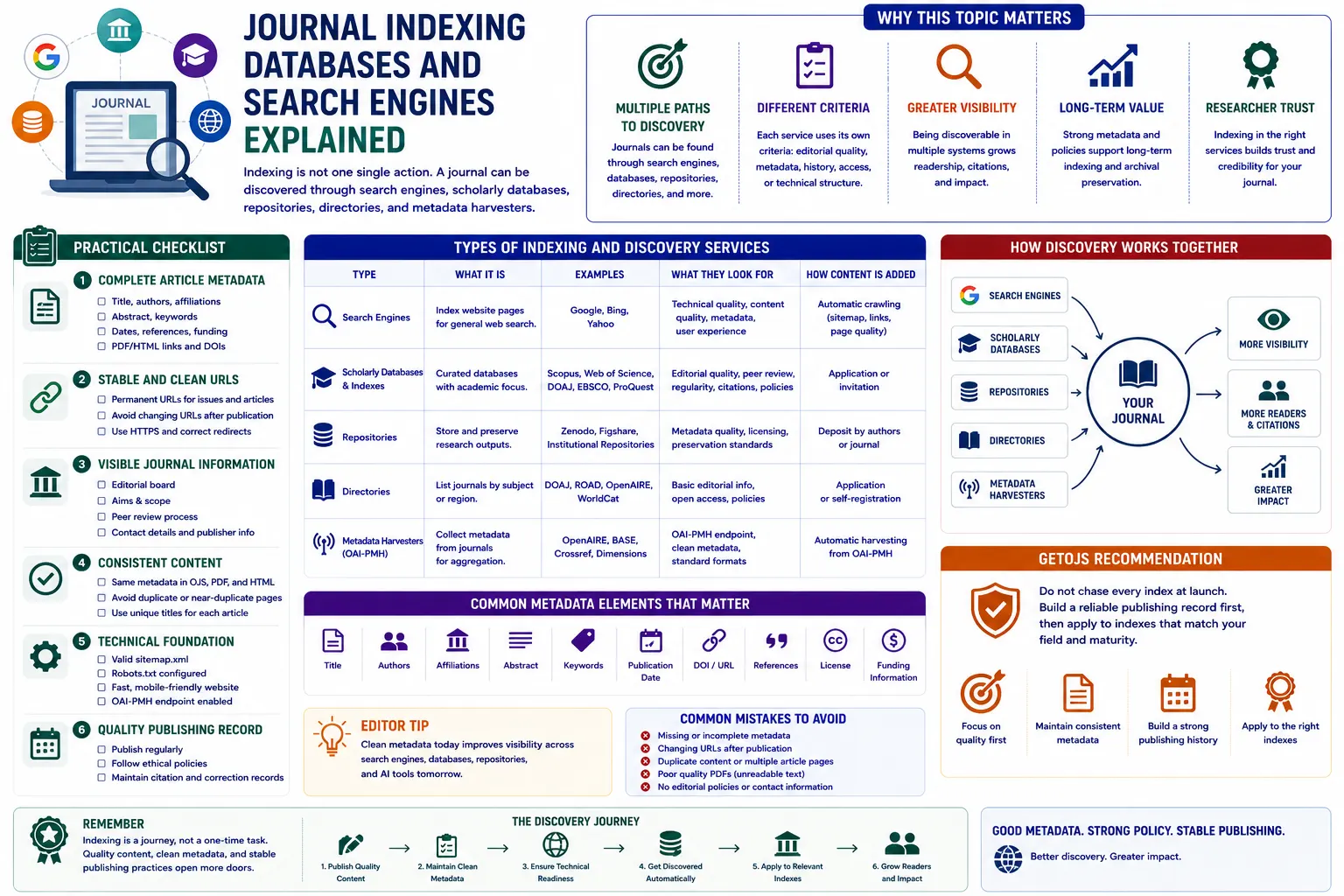
Indexing is not one single action. A journal can be discovered through search engines, scholarly databases, repositories, directories, and metadata harvesters. For many new journal teams, these words sound similar, but they serve different purposes. Understanding the difference helps editors build realistic visibility plans, avoid false indexing claims, and prepare their OJS website for long-term academic discovery.
Why indexing and discovery need clear understanding
When authors ask whether a journal is “indexed,” they are usually asking whether the journal is visible, trusted, and easy to verify. However, indexing can mean many things. A journal may appear in Google search results, have article pages crawled by Google Scholar, be listed in a directory, be harvested through metadata services, or be accepted by a selective citation database. These are not equal levels of recognition. Each system has its own purpose, technical requirements, quality checks, and update schedule.
For OJS journals, this distinction is very important because Open Journal Systems already provides many technical foundations for discovery. OJS can publish article metadata, issue archives, author names, abstracts, keywords, references, PDF galleys, DOIs, and OAI-PMH feeds. But the software alone cannot guarantee acceptance into every database. A journal also needs editorial quality, regular publishing activity, transparent policies, clean metadata, stable URLs, ethical publishing practices, and a clear subject scope.
Search engines vs scholarly indexing databases
General search engines such as Google, Bing, and other web crawlers mainly discover public web pages. They look for crawlable URLs, meaningful page titles, page speed, internal links, structured content, mobile usability, and non-blocked access. If your OJS article pages are public and your robots settings allow crawling, search engines may find your content. This helps readers discover the journal through ordinary web searches, but it does not mean the journal has passed a scholarly evaluation.
Scholarly indexing databases are different. They may evaluate the journal’s peer-review process, editorial board transparency, publication ethics, publication frequency, article quality, citation information, metadata consistency, and subject relevance. Some indexes are broad and multidisciplinary, while others are subject-specific. Some databases index journals at the title level, while others index individual articles. Some focus on metadata discovery, and some track citations. Because of this, journal teams should never use one general word like “indexed” without naming the actual service.
Directories, repositories, and metadata services
A journal directory is usually a listing service that helps users identify journals by title, subject, publisher, country, ISSN, access model, or policy information. Directories can support visibility and verification, but they may not index every article in the same way as a citation database. A repository, on the other hand, stores or exposes research outputs for access and preservation. Institutional repositories, subject repositories, and open-access repositories can help articles travel beyond the journal website.
Metadata services and harvesters work with structured information. They may use formats such as Dublin Core, Crossref metadata, OAI-PMH records, or other export formats. For an OJS journal, this is where clean metadata becomes powerful. If article titles, author names, ORCID iDs, affiliations, abstracts, keywords, references, funding statements, DOIs, and publication dates are entered correctly, discovery systems can understand the content better. Poor metadata can reduce visibility even when the article page itself looks attractive.
Why OJS metadata quality matters
Many journal teams focus on the homepage design, but indexing systems are more interested in structured article information. A beautiful homepage cannot fix missing abstracts, incorrect author spelling, duplicate URLs, broken PDF links, or inconsistent publication dates. In OJS, every published article should have complete metadata before it goes live. This includes a clear article title, accurate author sequence, affiliations, abstract, keywords, references, issue assignment, publication date, DOI where applicable, and properly uploaded galley files.
Editors should also check whether article metadata matches the PDF. If the article title in OJS differs from the title in the PDF, or if author names appear in a different order, it can create confusion for indexing services and readers. The same applies to references. If references are available only in the PDF but not entered or exposed properly in the journal system, some discovery services may not be able to process them fully.
Common indexing-related mistakes
- Using the phrase “indexed journal” without naming the exact database or search service.
- Claiming indexing before the journal is officially listed or before the article records are visible.
- Publishing articles with incomplete metadata, missing abstracts, broken PDFs, or unclear author affiliations.
- Changing article URLs after publication without proper redirects or long-term URL planning.
- Submitting to advanced indexes before the journal has enough publishing history, policies, and editorial evidence.
What search engines usually need from an OJS journal
Search engines need access, clarity, and consistency. The website should not block article pages with incorrect robots rules. The sitemap should include important pages such as the homepage, journal pages, issue pages, and article pages. The page title should clearly include the article title and journal name. The PDF should open properly, and internal links should help crawlers reach archives, current issues, editorial policies, and author guidelines.
Mobile performance also matters. Many users visit journal websites from phones, especially authors checking submission information or readers opening PDFs from search results. If the OJS theme has a broken mobile menu, oversized tables, overlapping text, or slow-loading banners, the user experience suffers. A clean, responsive OJS theme supports both readers and search visibility.
What scholarly databases usually review
Scholarly databases may look beyond technical access. They often review whether the journal has a defined aims and scope, qualified editorial board, peer-review policy, publication ethics statement, plagiarism policy, author guidelines, copyright and licensing information, article processing charge information, contact details, and consistent publication history. They may also check whether the journal publishes content relevant to its stated subject area and whether articles show academic quality.
This means journal teams should prepare the website before applying. The “About the Journal” page should be clear. The editorial board should include real names, roles, affiliations, and preferably institutional profiles. The peer-review process should explain how manuscripts are evaluated. The publication ethics page should cover author responsibilities, editor responsibilities, reviewer responsibilities, corrections, retractions, conflicts of interest, and plagiarism handling. These pages help readers and indexing reviewers understand that the journal is professionally managed.
Role of ISSN, DOI, and stable URLs
ISSN, DOI, and stable URLs support journal identity and article persistence. An ISSN identifies the serial publication. A DOI helps create a persistent article-level link when properly registered and maintained. Stable URLs ensure that published records remain accessible over time. However, having an ISSN or DOI does not automatically mean a journal is indexed in a selective database. These identifiers are useful foundations, but indexing still depends on the requirements of each discovery system.
In OJS, URL stability should be planned before launch. Avoid changing journal paths, article IDs, or public URL structures without redirects. If a journal migrates from another platform to OJS, old article URLs should be mapped carefully. Broken links can damage search visibility and frustrate authors who have already shared article links.
How to prepare an OJS journal for indexing
- Publish complete article metadata: title, authors, affiliations, abstract, keywords, dates, references, and PDF links.
- Maintain stable URLs for issues, articles, archives, galleys, and policy pages.
- Keep editorial policies, peer-review details, ethics statements, APC information, and contact details visible.
- Avoid duplicate article pages and inconsistent metadata across PDF, HTML, DOI records, and OJS records.
- Test OAI-PMH and metadata export settings when using repository or indexing integrations.
- Review the journal’s publication history before applying to selective databases.
How journal teams should communicate indexing status
Clear communication protects the journal’s reputation. Instead of saying “indexed in many databases,” list the exact databases, directories, repositories, or search services where the journal is actually present. If the journal is only submitted for evaluation, say “application submitted” or “under review” rather than “indexed.” If only article pages are visible in a search engine, do not present that as equivalent to acceptance in a scholarly citation database.
This is especially important for authors who need verified indexing for academic promotion, funding, or institutional requirements. Misleading claims can reduce trust and may create problems for both authors and publishers. A transparent indexing page should include the database name, journal profile link where possible, ISSN, and any conditions or coverage notes.
GetOJS recommendation
Do not chase every index at launch. Build a reliable publishing record first, then apply to indexes that match your subject area, quality level, and journal maturity. Start with strong OJS basics: clean article metadata, stable links, visible policies, mobile-friendly pages, working PDF access, and a consistent issue archive. Once the foundation is ready, indexing applications become more realistic and easier to manage.
GetOJS helps journal teams review technical readiness, improve metadata quality, configure OJS settings, clean article pages, fix navigation issues, and prepare indexing-friendly journal websites. The goal is not only to appear in more places, but to make the journal trustworthy, discoverable, and easier for authors, readers, reviewers, and indexing services to understand.
Need help applying this to your journal?
Our team can help configure, migrate, secure, customize, or maintain your OJS journal website.