
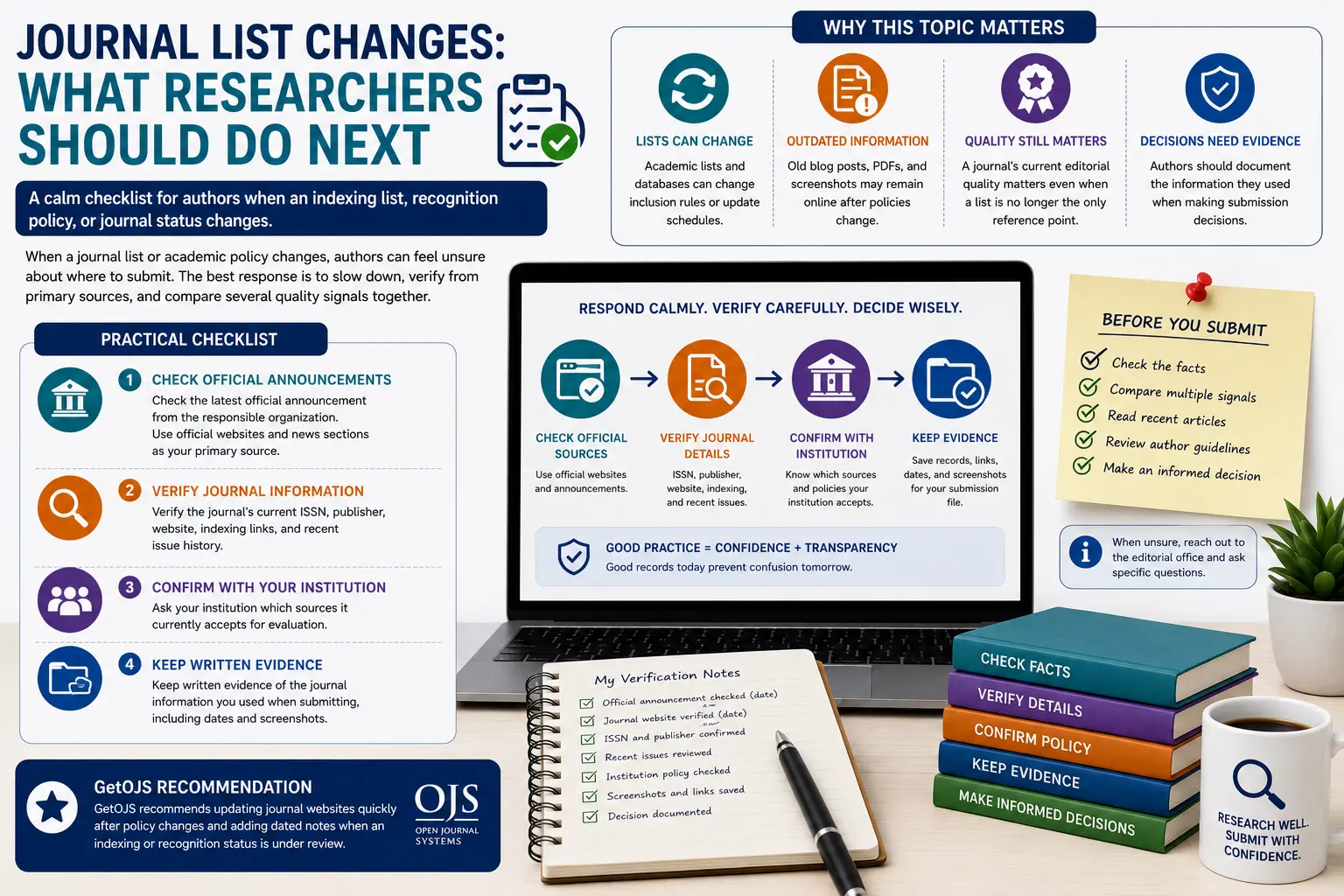
When a journal list, indexing database, university-approved list, or recognition policy changes, researchers often become confused about where to publish next. A journal that was acceptable last year may no longer be accepted for a current evaluation cycle, and a journal that claims indexing may need fresh verification. The best response is not panic, but a careful, evidence-based review of the journal’s current status, editorial quality, peer-review process, archive stability, and institutional requirements.
Why Journal List Changes Matter for Researchers
Academic publishing depends heavily on trust. Researchers submit their work to journals because they expect a fair peer-review process, long-term article availability, accurate metadata, DOI links, and recognition from academic institutions. When an approved journal list changes, it can affect Ph.D. submissions, faculty promotions, research funding, institutional assessments, and author confidence.
Journal list changes may happen for many reasons. A database may revise its selection criteria, an institution may update its publication policy, a journal may change publisher, a title may be discontinued from an index, or a new quality framework may replace an older list. These changes do not always mean every affected journal is poor quality. However, they do mean researchers must verify the current situation before submitting or citing a journal’s status in academic documents.
Common Reasons Journal Lists and Indexing Records Change
- Indexing databases update their evaluation rules and quality standards.
- Universities and academic bodies revise accepted publication criteria.
- Journals may change publisher, website domain, ISSN record, or publication frequency.
- Some journals may fail to maintain peer review, metadata, ethics, or publishing transparency.
- Old lists, PDFs, and screenshots may remain online after official policies are updated.
First Step: Verify the Latest Official Source
The first step for researchers is to identify the official source responsible for the list or recognition policy. Do not rely only on WhatsApp forwards, old PDF files, screenshots, third-party blogs, or journal promotional banners. Instead, visit the official website of the indexing database, university, commission, professional body, or journal evaluation authority.
Check the publication date of the announcement and compare it with your submission date. This is important because many academic evaluations consider whether the journal was valid during a specific publication period. If your paper was accepted before a list change but published afterward, your institution may apply a different rule. Always ask your department, research cell, or academic office for written clarification when the timeline is important.
Check the Journal Title, ISSN, and Publisher Details
Many researchers make the mistake of checking only the journal name. This can be risky because similar journal titles, cloned websites, changed publishers, or discontinued records can create confusion. Always verify the exact title, print ISSN, online ISSN, publisher name, journal website, subject area, and coverage years.
If the journal has both old and new websites, verify which website is officially linked from the indexing record. If the journal has changed publisher, confirm whether the indexing record refers to the current publisher or an older version of the journal. If the ISSN does not match, treat the claim carefully until you can confirm it through an official database or institutional source.
Understand Active, Discontinued, and Under-Review Status
Journal status is not always simple. A title may be currently indexed, previously indexed, discontinued, under evaluation, temporarily removed, or accepted only for certain coverage years. For authors, this difference matters. A journal may show past records in a database, but that does not automatically mean all future articles will be covered.
Before submitting, check whether the journal is currently active in the database and whether recent articles are being indexed. If the journal was discontinued, identify the year of discontinuation and confirm how your institution treats articles published before and after that date. This protects you from relying on outdated claims.
Evaluate the Journal Beyond List Status
A journal list is only one signal. Researchers should also assess the journal’s actual publishing quality. A credible journal should have a clear aims and scope page, named editorial board members, transparent peer-review policy, publication ethics, plagiarism policy, article processing charge information, archive pages, DOI links, author guidelines, and contact details.
Read recent articles from the journal. Check whether the formatting is consistent, references are complete, author affiliations are clear, abstracts and keywords are meaningful, and article pages have stable URLs. Good journals maintain quality even when policies change around them. Poor journals often depend only on indexing claims and do not provide enough editorial transparency.
Practical Checklist for Researchers
- Check the latest official announcement about the journal list or indexing change.
- Verify the journal by exact title, ISSN, publisher, website, and subject category.
- Confirm whether the journal is active, discontinued, changed, or under review.
- Review the journal’s recent issues, peer-review policy, ethics page, and publication charges.
- Ask your institution which lists or databases are accepted for your evaluation period.
- Save proof such as official records, screenshots with dates, email confirmations, and policy documents.
What to Do If Your Submitted Journal Status Changes
If you have already submitted an article and the journal’s list status changes, do not immediately withdraw your paper without checking the facts. First, identify whether the change affects future submissions only, all future publications, or past coverage as well. Then contact the journal office and ask for clarification about current indexing, DOI registration, expected publication date, and archive policy.
If the article is still under review and the journal no longer meets your institutional requirements, you may decide to withdraw and submit elsewhere. If the article is already accepted or published, collect all documents related to the submission timeline, acceptance date, publication date, DOI, and indexing proof. Your institution may need this information during assessment.
What Journal Publishers Should Do After a List Change
Journal publishers should respond to list changes with transparency. The journal website should be updated quickly with dated notices about current indexing, under-review status, or discontinued records. Publishers should avoid misleading phrases such as “indexed everywhere” or “approved journal” unless they can link to current official evidence.
Clear communication builds trust. Add an indexing page that shows verified databases, coverage years, DOI registration details, archiving information, and last updated date. If a journal is applying for indexing, state that it is “under evaluation” instead of claiming approval before confirmation.
How OJS Helps Maintain Reliable Journal Records
Open Journal Systems (OJS) can help journals maintain professional publishing records. A well-configured OJS website can display current issues, archives, article metadata, editorial policies, author guidelines, peer-review workflow, DOI information, and indexing pages in a structured way.
For researchers, this makes verification easier. For publishers, it supports long-term credibility by keeping submissions, reviews, decisions, issues, article pages, and metadata organized. When a journal list changes, an updated OJS site helps authors see the latest information instead of depending on outdated brochures or third-party claims.
Red Flags Researchers Should Avoid
- No clear editorial board or reviewer policy.
- Very fast acceptance without meaningful review.
- Indexing logos shown without official source links.
- Mismatch between journal title, ISSN, publisher, and website.
- No archive stability, DOI information, ethics policy, or contact transparency.
Frequently Asked Questions
What should I do if an approved journal list changes?
Check the latest official announcement, verify the journal’s current status, and ask your institution how the change applies to your publication period.
Does removal from a list mean all old articles are invalid?
Not always. Many institutions evaluate articles based on the journal’s status at the time of submission, acceptance, or publication. You should confirm the rule with your institution.
Can a journal still be good if it is not on a specific list?
Yes, but it depends on your goal. For academic evaluation, you must follow institutional rules. For research visibility, you should also check peer review, ethics, metadata, DOI, archive quality, and readership.
How can journals prevent confusion after list changes?
Journals should maintain a dated indexing page, link to official records, update author guidelines, and avoid unsupported indexing claims.
GetOJS Recommendation
GetOJS recommends updating journal websites quickly after policy changes and adding dated notes when an indexing or recognition status is under review. Journals should keep their indexing page, editorial policies, DOI records, contact details, and archive pages accurate so researchers can verify information confidently.
Need help applying this to your journal?
Our team can help configure, migrate, secure, customize, or maintain your OJS journal website.