
Quick answer
OJS maintenance cost depends on journal scale, hosting responsibility, support coverage, response targets, software age, customizations, integrations, security controls, backup retention, and expected change volume. A useful annual plan defines preventive work as well as incident response.
What OJS maintenance should mean
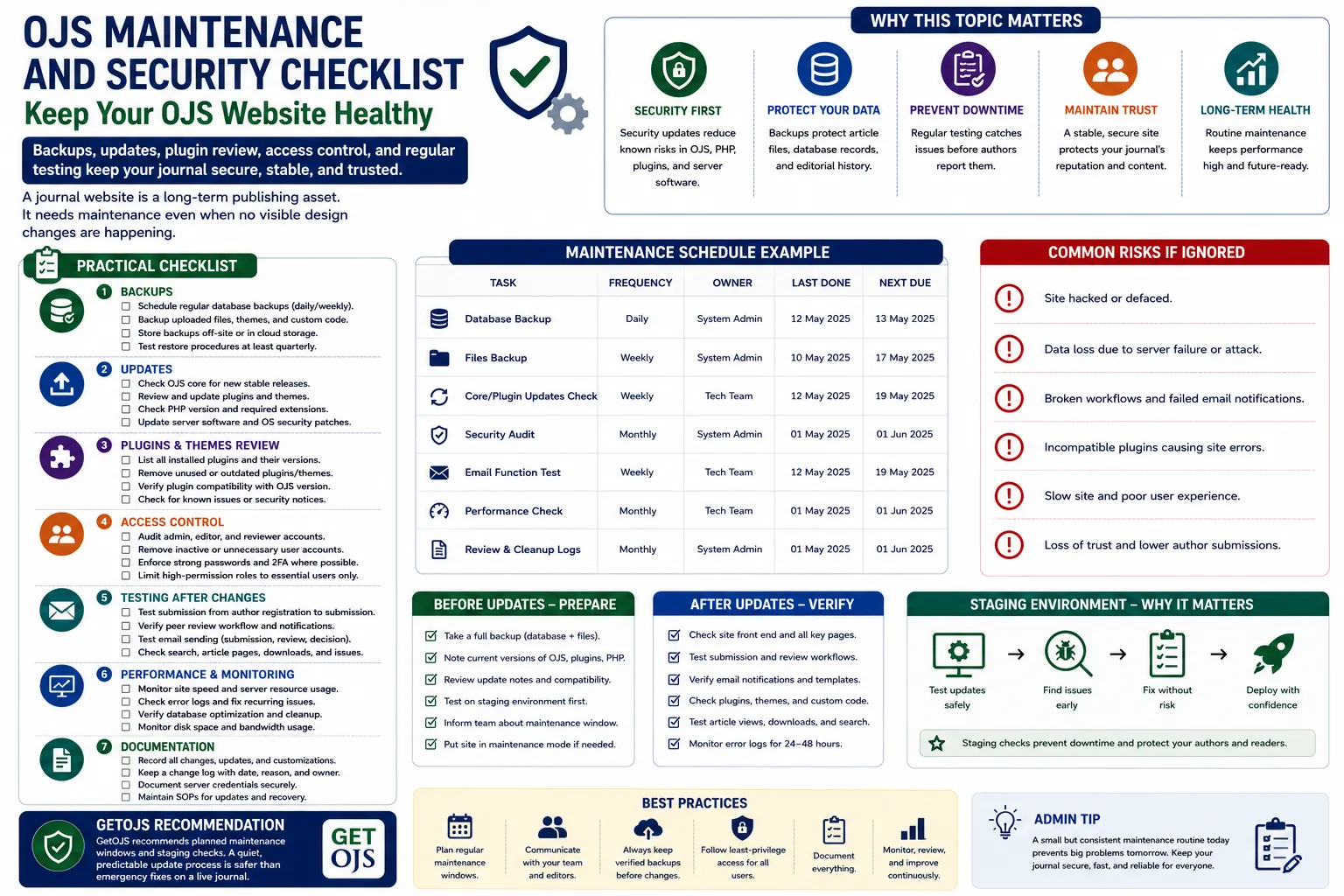
Maintenance is not only fixing the website after it breaks. It is a repeatable process for monitoring, backups, restoration readiness, security, supported software, email delivery, storage, performance, logs, scheduled tasks, plugin and theme compatibility, and editor support. It should also prepare the journal for future upgrades.
A generic hosting plan may keep a server online without checking OJS workflows. An OJS-aware plan should understand why submission email fails, why a scheduled task stops, why a plugin changes metadata, why file permissions matter, or why a theme breaks after a release.
What affects annual OJS maintenance cost?
- Number and activity of journals: more sites, submissions, editors, users, articles, and integrations create more operational work.
- Infrastructure responsibility: fully managed hosting includes more server work than application-only support on client-owned hosting.
- Software condition: old OJS, PHP, database, plugins, and undocumented customizations need more monitoring and remediation.
- Support level: business-hours email, priority incident response, phone access, and guaranteed targets have different staffing costs.
- Backup and recovery: frequency, retention, off-site copies, encryption, storage volume, and restoration tests affect the plan.
- Change allowance: content updates, theme edits, plugin configuration, training, reports, and custom development may be included, limited, or separate.
Compare maintenance plans by responsibility, not labels
| Coverage model | Suitable for | Confirm before purchase |
|---|---|---|
| Monitoring and backup | Institutions with internal OJS and server expertise | Alert ownership, retention, restore tests and incident handoff |
| Application maintenance | Teams that manage hosting but need OJS help | Version support, plugins, themes, logs, email and included hours |
| Managed hosting and support | Editorial teams transferring technical operations | Infrastructure, backups, security, OJS work, support limits and access |
| Institutional support | Publishers or universities with several journals | Central contact, isolation, governance, reporting, training and escalation |
Marketing names such as Basic, Professional, Premium, or Enterprise are not standardized. Compare the written service schedule behind each label.
Annual OJS maintenance checklist
- Daily or continuous: uptime, storage, security alerts, failed jobs, error logs, email queues, backups, and certificate health.
- Weekly: backup success review, suspicious accounts and submissions, scheduled tasks, disk growth, and critical workflow incidents.
- Monthly: restore sample, update review, plugin inventory, performance check, email deliverability, broken public pages, and support report.
- Quarterly: staging test, permissions, administrator accounts, recovery contacts, domain and DNS ownership, integration checks, and documentation updates.
- Annually: supported-version plan, full recovery exercise, storage forecast, theme and plugin roadmap, security review, data-retention review, and renewal scope.
What is commonly included—and commonly excluded
Routine plans may include monitoring, backups, SSL, minor configuration, security review, supported updates, log checks, troubleshooting, and a defined number of support requests. Major upgrades, hosting migrations, large archive imports, new custom themes, plugin development, content entry, policy writing, DOI fees, and recovery from pre-existing compromise may be separate projects.
Neither approach is wrong if it is transparent. Problems begin when “full maintenance” is sold without a schedule, limits, response targets, or exclusions. Ask for examples of included and billable requests.
The cost of reactive-only OJS support
Buying help only after an outage can appear cheaper during quiet months, but emergency investigation begins without current backups, documentation, staging, or system knowledge. The journal may already be losing submissions, email, reader access, and editorial time. Urgent repairs also carry greater risk because decisions happen under pressure.
Preventive maintenance creates a known baseline. The provider knows the versions, infrastructure, normal logs, integrations, and recovery process before an incident. That does not eliminate every failure, but it can reduce detection and recovery time.
How to read an OJS support SLA
Response time means when the provider acknowledges and starts triage; it is not a promise that every issue will be resolved within that period. Resolution depends on severity, access, reproduction, third-party services, custom code, and whether a safe fix requires staging.
The agreement should define severity levels, service hours, emergency contacts, excluded events, maintenance windows, communication frequency, escalation, client responsibilities, and how unused or excess support hours are handled. For hosting, also clarify uptime measurement and service credits if offered.
Checklist for requesting an OJS annual support quote
- Provide OJS, PHP and database versions; journal count; storage; traffic; user count; plugins; theme; integrations; and current hosting ownership.
- List recurring problems, expected changes, publishing calendar, critical periods, internal technical capacity, and required support channels.
- Ask which versions are supported and how upgrades, security releases, plugin changes, and staging are handled.
- Request backup contents, frequency, retention, location, encryption, restoration testing, and recovery responsibilities.
- Request included hours or tasks, exclusions, response targets, renewal terms, exit assistance, data export, and ownership terms.
Build a sustainable annual OJS budget
Budget separately for hosting, maintenance, major upgrades, custom improvements, third-party services, editorial operations, production work, DOI activity, training, and contingency. Do not assume an annual hosting invoice covers every publishing or development task.
The right maintenance budget is the one that matches the journal's risk and internal capacity. A small journal with skilled university IT has different needs from a publisher operating many journals without an internal server team. Review the scope each year as submissions, archives, integrations, software versions, and staff change.
Frequently asked questions
How much does OJS maintenance cost per year?
Annual cost varies by journal count, activity, hosting responsibility, software condition, support hours, response targets, backup policy, customizations, integrations, and included changes. Compare a written scope rather than plan names.
What should OJS maintenance include?
A practical plan can include monitoring, backups, restoration checks, security, supported updates, logs, email, scheduled tasks, storage, performance, plugins, themes, troubleshooting, documentation, and upgrade planning.
Is OJS hosting the same as OJS maintenance?
Not always. Hosting supplies infrastructure, while maintenance covers the application and operational care. Managed OJS hosting may combine both, but the exact responsibilities must be listed.
Are major OJS upgrades included in annual support?
Some plans include scheduled upgrades, some include only readiness review or minor updates, and others quote major upgrades separately. Confirm staging, compatibility work, downtime, and testing.
How often should OJS backups be tested?
Backup jobs should be reviewed continuously, and restoration should be tested on a defined schedule appropriate to journal activity and risk. A backup is not fully trusted until recovery has been demonstrated.
Official sources and further reading
Product versions, support timelines, technical requirements, and third-party policies can change. Verify current details with the responsible organization before making a production decision.
Need a scoped OJS quotation?
GetOJS can review your journal, explain the work and provide a written scope without promising third-party indexing or ranking outcomes.