
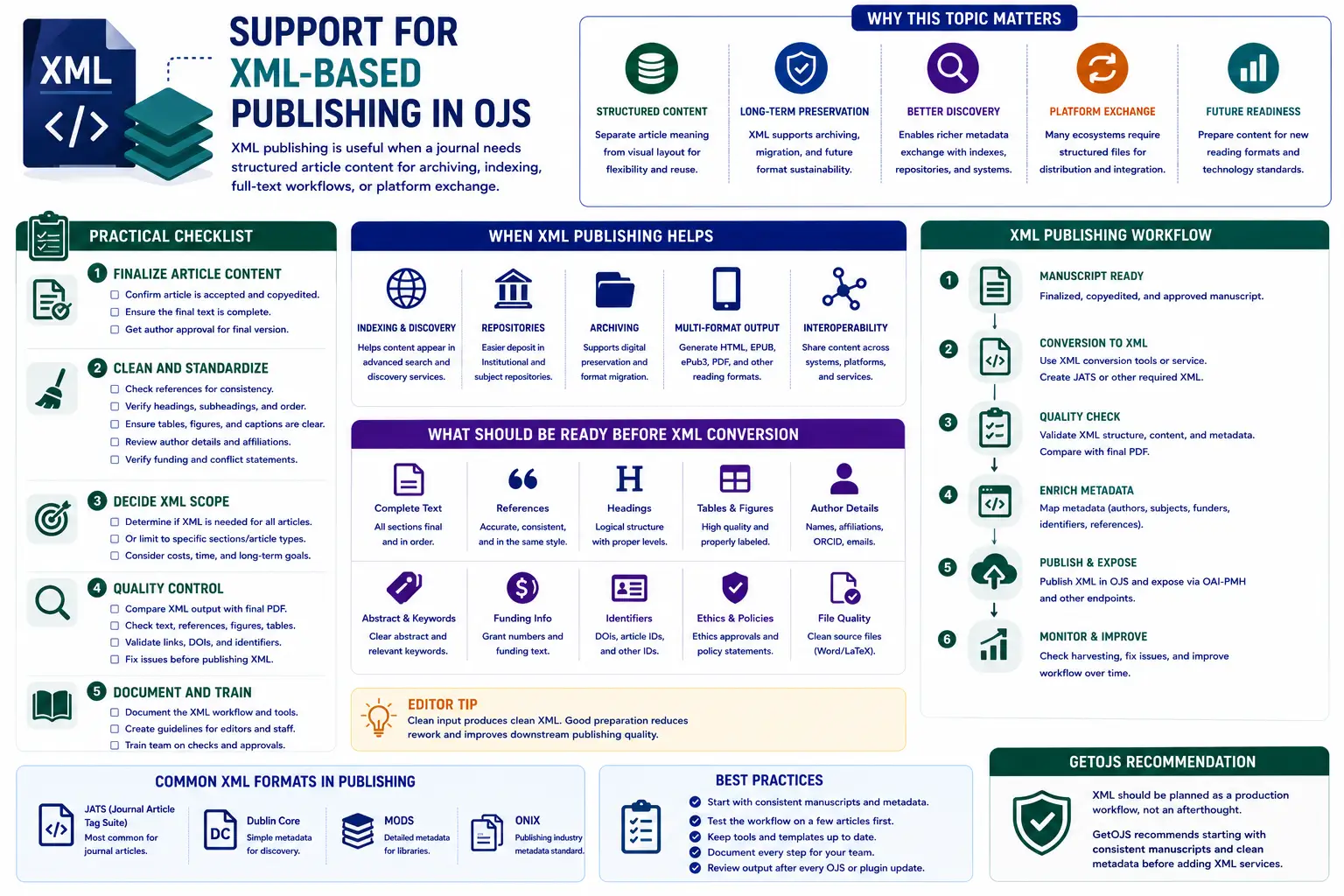
XML publishing is useful when a journal needs structured article content for archiving, indexing, full-text workflows, platform exchange, and long-term digital preservation.
Introduction
In many journal websites, the final published article is treated mainly as a PDF file. The PDF is important because it gives readers a stable, printable, and familiar version of the article. However, modern scholarly publishing often needs more than a visually formatted document. Indexing platforms, repositories, preservation systems, metadata harvesters, and full-text discovery services need structured information that can be read by machines. This is where XML-based publishing becomes valuable for Open Journal Systems journals.
XML publishing means that article content is prepared in a structured format where each part of the article has a clear meaning. The title, authors, affiliations, abstract, keywords, headings, references, tables, figures, funding details, acknowledgements, and article body are marked in a way that systems can understand. Instead of only showing how the article looks, XML explains what each article element is. This makes it easier to reuse, validate, preserve, transform, and exchange article content across multiple publishing environments.
For an OJS journal, XML support can improve professional publishing quality, but it should not be treated as a simple upload feature. A good XML workflow requires clean manuscripts, consistent editorial policies, accurate metadata, properly formatted references, and quality checks before publication. If the manuscript data is incomplete or inconsistent, the XML output may also become unreliable. Therefore, XML publishing should be planned as part of the production workflow, not added only at the end of publication.
Why XML-Based Publishing Matters
- Structured content helps separate article meaning from visual layout, making articles easier to process, archive, and transform.
- XML can support long-term preservation, metadata exchange, full-text indexing, and compatibility with external scholarly platforms.
- Some publishing ecosystems, repositories, and indexing workflows require richer structured files than simple PDFs.
- XML makes it easier to create multiple article outputs, such as HTML, PDF, EPUB, metadata feeds, and archive-ready packages.
The main benefit of XML is consistency. A well-prepared XML article can identify every major component of a research paper in a predictable way. This is useful for search systems that need to understand article titles, author names, references, and abstracts. It is also useful for preservation services that want reliable files for long-term access. When journals publish only PDFs, important information may remain locked inside the visual document. XML helps unlock that information and makes it easier for other systems to use the article responsibly.
XML also supports discoverability. If article metadata and full-text elements are structured correctly, the content can be understood more clearly by indexing and repository systems. This can help journals that want stronger visibility beyond their own website. For example, article references can be parsed, author information can be linked more accurately, funding details can be identified, and abstracts can be reused in discovery platforms. The result is a more connected publishing record.
How XML Fits into an OJS Workflow
OJS already manages many important parts of the journal workflow: submission, review, editorial decisions, copyediting, production, issue assignment, publication, and metadata management. XML-based publishing fits most naturally into the production stage, after the article has been accepted and after the main text has been finalized. At this point, the production team can prepare the article for structured conversion without worrying that major content changes will keep appearing.
A typical workflow starts with the final accepted manuscript or copyedited document. The production team checks headings, author details, abstracts, keywords, tables, figures, citations, references, funding statements, ethical declarations, and supplementary files. After this cleanup, the article can be converted into XML. The XML file should then be validated, compared with the final PDF, and checked for missing content. Only after these checks should the XML be treated as part of the official article package.
For journals that publish frequent issues, it is important to decide whether XML conversion will be done for every article or only for selected article types. Research articles, review articles, case reports, editorials, and short communications may have different structures. If the journal wants a consistent XML workflow, it should define templates and rules for each article type. This prevents confusion during production and makes the output more reliable.
What Should Be Clean Before XML Conversion
XML conversion becomes easier when the manuscript is already clean and consistent. The production team should not wait until the conversion step to fix every issue. A good XML workflow begins with clean editorial preparation. Article titles should be final. Author names should be spelled consistently. Affiliations should be complete. Abstracts should be placed in the correct section. Keywords should be separated clearly. Headings should follow a logical hierarchy. References should have consistent punctuation, author order, journal titles, volume numbers, issue numbers, page ranges, years, and DOIs where available.
Tables and figures also need attention. Captions should be clear and connected to the correct table or figure. Figure files should be named properly and should match the citations in the article text. Supplementary material should be described correctly. If the article contains equations, special characters, non-English text, or complex formatting, the production team should check whether these elements are represented correctly in the XML output.
Another important area is ethical and funding information. Many journals now include conflict of interest statements, informed consent statements, ethics approval details, data availability statements, funding details, and author contribution statements. If these elements are important to the journal, they should be consistently included in the manuscript and metadata. XML can capture these sections more clearly when they are prepared in a predictable way.
Practical Checklist
- Finalize accepted article text before conversion so the XML does not need repeated major corrections.
- Clean references, headings, tables, figures, author details, funding statements, and ethical declarations.
- Decide whether XML is needed for all articles or only selected article types, issues, or journal sections.
- Create a quality-control step to compare XML output against the final PDF and public article page.
- Validate XML files before delivery, archiving, or integration with external services.
- Document your XML process so editors, copyeditors, and production staff follow the same standards.
XML and Article Metadata
XML publishing is closely connected to metadata quality. Even if the article body is converted correctly, poor metadata can reduce the value of the structured output. OJS article records should include accurate titles, subtitles where needed, author names, ORCID IDs when available, affiliations, countries, abstracts, keywords, publication dates, issue details, page numbers or article numbers, DOI information, licensing details, and language information. These details help external systems understand the article record.
Metadata should be reviewed before XML conversion because the XML file may pull or represent these values. If an author affiliation is missing in OJS, or if the DOI is incorrect, the structured output may carry that mistake. For this reason, XML support should be linked with a metadata audit. Journals can create a pre-publication checklist where editorial staff confirm that all required metadata fields are complete before final publication.
Benefits for Readers, Editors, and Publishers
Readers may not directly see the XML file, but they benefit from better article presentation and discovery. XML can support clean HTML article views, better search experiences, and improved accessibility when used properly. Readers who prefer web-based reading may find full-text HTML easier than downloading a PDF every time. XML can also help create outputs that work better across devices, screen sizes, and assistive technologies.
Editors benefit because structured publishing encourages consistency. When the journal has a defined XML workflow, the editorial team becomes more careful about article sections, references, metadata, and final checks. This can improve the overall quality of publication. Publishers benefit because XML can support long-term content management, platform migration, indexing support, preservation, and future format conversion. If the journal changes its website or publishing platform later, structured content is easier to move than unstructured files.
Common Mistakes to Avoid
One common mistake is assuming that XML conversion will automatically fix poor manuscript preparation. It will not. If the references are inconsistent, tables are unclear, or metadata is incomplete, the XML team will need more time to correct the content. Another mistake is converting articles before the final text is approved. This creates duplicate work because every later correction must be reflected in the XML file, PDF, HTML, and article metadata.
Journals should also avoid treating XML as a one-time technical task. XML is a publishing process. It needs clear responsibilities, quality control, and documentation. The team should know who prepares source files, who checks references, who validates XML, who compares output against the PDF, and who approves the final publication package. Without this process, XML support can become inconsistent across issues.
Another risk is ignoring version compatibility and plugin behavior. If the journal uses OJS plugins or custom themes for XML display, the technical team should test them after OJS upgrades. A plugin or theme change may affect how XML or full-text HTML is displayed. Therefore, testing on a staging site is always safer than making changes directly on the live journal.
When a Journal Should Consider XML Publishing
A journal should consider XML publishing when it wants stronger discoverability, full-text indexing, structured archiving, better preservation, or professional multi-format publishing. XML is also useful when the journal works with repositories, aggregators, indexing services, or preservation partners that expect structured content. Journals with high publication volume may benefit from a standardized XML process because it can improve consistency across articles and issues.
However, not every small journal needs to begin with a complex XML workflow immediately. If the journal is still struggling with basic metadata, author guidelines, DOI setup, issue publication, or editorial workflow, it may be better to fix those foundations first. XML produces the best results when the journal already has stable editorial and production practices. A phased approach is often better: clean metadata first, improve manuscript templates next, standardize references and article sections, and then add XML conversion and validation.
GetOJS Recommendation
XML should be planned as a production workflow, not an afterthought. GetOJS recommends starting with consistent manuscripts, clean metadata, correct references, stable article templates, and a clear quality-control process before adding XML services. This helps the journal avoid repeated correction cycles and improves the reliability of the final structured output.
For OJS journals, the best XML publishing support is not only about producing a file. It is about building a dependable publication process. The journal should know why it needs XML, which article types require it, what metadata must be complete, who will check the output, and how the XML will be used after publication. When these questions are answered clearly, XML can become a strong part of the journal’s publishing infrastructure.
Need help applying this to your journal?
Our team can help configure, migrate, secure, customize, or maintain your OJS journal website.