
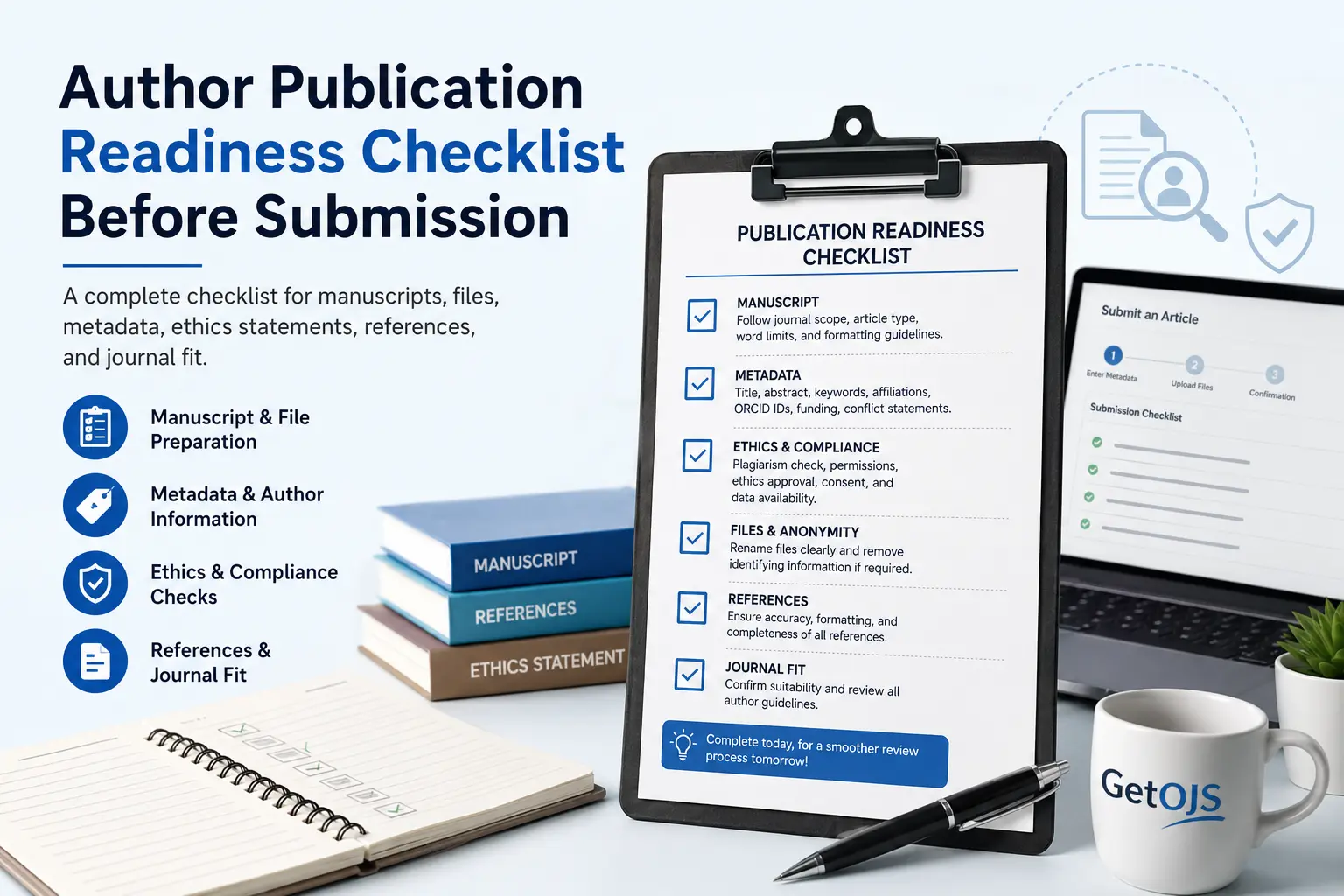
Many manuscript delays happen before peer review begins. Authors can avoid preventable corrections by preparing manuscript files, journal metadata, author details, references, ethical declarations, figures, and supplementary materials carefully before submission.
Introduction
Submitting a research paper to an academic journal is not only about uploading a manuscript. A successful journal submission requires planning, accuracy, transparency, and compliance with the journal's author guidelines. Editors often check the technical quality of a submission before they send it for peer review. If important details are missing, the manuscript may be returned to the author for correction, delayed for several weeks, or rejected at the initial screening stage.
For researchers, faculty members, Ph.D. scholars, postgraduate students, and academic authors, a publication readiness checklist is a practical tool that helps reduce mistakes before submission. It ensures that the manuscript is complete, properly formatted, ethically prepared, and suitable for the selected journal. This guide is especially useful for authors submitting to journals managed through Open Journal Systems, open access journals, peer-reviewed journals, institutional journals, and international academic publications.
Why Publication Readiness Matters
A well-prepared manuscript creates a strong first impression. Editors receive many submissions, and incomplete files make the screening process difficult. When authors submit complete information from the beginning, editors can quickly evaluate the manuscript, assign reviewers, and move the article through the publication workflow.
- Complete submissions are easier for editors to screen, assign, and track.
- Accurate metadata improves indexing, search visibility, and article discovery after publication.
- Clear ethical statements protect authors, editors, reviewers, publishers, and readers.
- Proper files and references reduce correction requests during editorial and production stages.
1. Confirm Journal Scope and Article Fit
Before submitting your research paper, confirm that the journal publishes work related to your subject area. A manuscript may be strong, but if it does not match the aims and scope of the journal, it can be rejected without peer review. Authors should carefully read the journal's scope, recently published articles, accepted article types, publication frequency, indexing details, and editorial policies.
Check whether the journal accepts original research articles, review papers, short communications, case studies, technical notes, book reviews, or conference papers. Also verify whether your research topic matches the journal's audience. Choosing the right journal saves time and increases the chance of successful publication.
2. Review Author Guidelines Carefully
Every journal has its own submission requirements. Some journals require a specific manuscript template, while others provide instructions for headings, citation style, word limits, table formatting, figure resolution, and supplementary files. Ignoring these guidelines is one of the most common reasons for manuscript return.
Before submission, verify the required format for title page, abstract, keywords, references, figures, tables, author details, conflict of interest statement, funding information, and ethics approval. If the journal uses OJS, ensure that the information entered during submission matches the manuscript file exactly.
3. Prepare a Clear and Search-Friendly Title
The title is one of the most important parts of your manuscript. It helps editors understand the topic quickly and also improves discoverability in search engines, indexing databases, institutional repositories, and Google Scholar. A good title should be specific, concise, and relevant to the research objective.
Avoid vague titles, unnecessary abbreviations, and overly long phrases. Include important subject keywords naturally. For example, instead of using a broad title such as "A Study on Education", a stronger title would clearly mention the population, method, region, or research focus.
4. Strengthen the Abstract
The abstract is often the first section read by editors, reviewers, and readers. It should summarize the purpose, methodology, major findings, and conclusion of the study. A strong abstract improves the readability of the article and helps potential readers decide whether the paper is relevant to their research.
Keep the abstract within the journal's word limit. Avoid citations unless the journal allows them. Use clear academic language and include the main contribution of the study. For SEO and indexing, include important terms related to the research topic, but avoid keyword stuffing.
5. Choose Accurate Keywords
Keywords help search engines, journal platforms, and indexing databases understand the subject of your article. They also help readers discover your research through search queries. Most journals ask authors to provide five to eight keywords.
Select keywords that represent the main topic, method, discipline, and application area of your research. Do not repeat only the words used in the title. Use a mix of broad and specific terms. For example, a technology article may include keywords related to artificial intelligence, machine learning, data analysis, healthcare applications, or prediction models depending on the research focus.
6. Verify Author Details and Affiliations
Incorrect author information can create serious publication and indexing issues. Before submission, confirm the spelling of each author's name, institutional affiliation, department, city, country, and email address. The corresponding author should be clearly identified because all editorial communication will usually be sent to that person.
Authors should also add ORCID IDs where required. ORCID helps connect researchers with their publications and reduces confusion when multiple authors have similar names. Accurate author metadata is especially important for DOI registration, citation tracking, indexing, and institutional records.
7. Check Manuscript Structure
A research article should follow a logical structure. Although requirements vary by journal and discipline, most manuscripts include title, abstract, keywords, introduction, literature review, methodology, results, discussion, conclusion, acknowledgements, declarations, and references.
The introduction should explain the background, research gap, and objective. The methodology should be detailed enough for readers to understand how the study was conducted. The results should present findings clearly, while the discussion should interpret those findings in relation to previous research. The conclusion should summarize the contribution without introducing new data.
8. Improve Language and Readability
Clear writing improves the review experience. Reviewers should be able to understand the purpose, methods, and results without struggling through unclear sentences. Authors should proofread the manuscript for grammar, spelling, punctuation, consistency, and academic tone.
Avoid very long paragraphs, repeated ideas, and informal language. Use headings and subheadings where appropriate. If necessary, ask a colleague, supervisor, or professional editor to review the manuscript before submission.
9. Review Figures, Tables, and Captions
Figures and tables should support the research findings and not repeat the same information unnecessarily. Each figure and table must be numbered correctly and cited in the text. Captions should be descriptive enough to explain the content clearly.
Ensure that images are high resolution, charts are readable, table formatting is clean, and permissions are available for any reused material. Low-quality images can delay publication because production teams may ask authors to submit replacement files.
10. Verify References and Citations
References are a major part of academic credibility. Incorrect references can weaken the manuscript and create extra editorial work. Authors should ensure that every in-text citation appears in the reference list and every reference is cited in the manuscript.
Check author names, article titles, journal names, volume numbers, issue numbers, page numbers, publication years, and DOI links. Use the citation style required by the journal, such as APA, MLA, Chicago, Vancouver, IEEE, or any journal-specific style. Reference managers like Zotero, Mendeley, and EndNote can help, but final manual checking is still important.
11. Check Plagiarism and Originality
Originality is essential for scholarly publishing. Authors should review the manuscript for copied text, improper paraphrasing, duplicate publication, and self-plagiarism. Even when the research is original, poor citation practice can create similarity issues.
Before submission, check that all borrowed ideas, data, tables, images, and direct quotations are properly cited. If your institution provides plagiarism detection software, review the similarity report and correct problematic sections before submitting to the journal.
12. Add Ethical Declarations
Ethical transparency is required by many peer-reviewed journals. Depending on the study type, authors may need to provide ethics committee approval, informed consent, animal ethics approval, clinical trial registration, patient consent, data availability statements, and permissions for copyrighted content.
Even if ethical approval is not applicable, some journals require authors to state that clearly. Missing ethical declarations can delay editorial decisions and may prevent the manuscript from moving forward.
13. Include Funding and Conflict of Interest Statements
Funding and conflict of interest statements help readers understand whether financial or personal relationships may have influenced the research. Authors should clearly mention funding agencies, grant numbers, institutional support, or state that no funding was received.
Similarly, conflict of interest declarations should be honest and complete. If there is no conflict, include a simple statement such as "The authors declare no conflict of interest." Follow the exact wording required by the journal.
14. Prepare Files for OJS Submission
Many journals use Open Journal Systems to manage manuscript submission, peer review, copyediting, production, and publication. In OJS, authors usually upload manuscript files, enter metadata, add contributors, confirm submission requirements, and communicate with the editorial team.
Prepare your files with clear names such as Manuscript.docx, Title-Page.docx, Figure-1.png, Supplementary-File.pdf, and Cover-Letter.docx. Avoid confusing file names like final-version-new-latest-edited.docx. If the journal follows double-blind peer review, remove author names and identifying information from the manuscript file before upload.
15. Write a Professional Cover Letter
Some journals ask authors to submit a cover letter. A good cover letter should briefly introduce the manuscript title, article type, research contribution, originality statement, and journal fit. It should also confirm that the manuscript is not under consideration elsewhere.
Keep the cover letter short and professional. Avoid exaggeration. Focus on why the article is suitable for the journal and how it contributes to the subject area.
16. Final Pre-Submission Checklist
- Confirm the journal scope, article type, author guidelines, word limit, template, and publication policies.
- Prepare title, abstract, keywords, author affiliations, ORCID IDs, funding details, and conflict statements.
- Check plagiarism, permissions, ethics approval, consent statements, and data availability requirements.
- Review figures, tables, captions, supplementary files, references, and DOI details.
- Rename files clearly and remove identifying information if the review model requires anonymity.
Common Mistakes Authors Should Avoid
Many publication delays are caused by small but important mistakes. Authors should avoid uploading the wrong manuscript version, submitting incomplete metadata, forgetting declarations, using poor-quality images, ignoring reference style, selecting the wrong article type, and missing supplementary files.
Another common issue is mismatch between the manuscript and the information entered in the submission system. For example, the author order, title, abstract, and keywords in OJS should match the manuscript exactly. Consistency helps editors, copyeditors, and production teams process the article smoothly.
How GetOJS Helps Journals Improve Submission Quality
GetOJS recommends that journals add a clear author submission checklist inside the author guidelines and mirror the same requirements inside OJS submission steps. This helps authors submit complete manuscripts and reduces repeated editorial corrections.
Our team helps journals with new journal setup, OJS upgrade, OJS migration, OJS theme development, OJS plugin development, ISSN guidance, DOI setup, editorial workflow configuration, and journal website maintenance.
Conclusion
Publication success begins before peer review. A complete and carefully prepared submission saves time for authors, editors, reviewers, and publishers. By following this author publication readiness checklist, researchers can improve manuscript quality, reduce preventable delays, and increase the chances of a smooth journal submission process.
Before submitting your next research paper, take time to review the journal scope, manuscript structure, metadata, ethical declarations, references, figures, and OJS submission files. A few extra minutes of checking can save weeks of correction and communication later.
Frequently Asked Questions
What is an author publication readiness checklist?
An author publication readiness checklist is a final review list used before journal submission. It helps authors confirm that the manuscript, metadata, references, ethical statements, files, and declarations are complete.
Why do journals return manuscripts before peer review?
Journals may return manuscripts because of missing files, incorrect formatting, incomplete metadata, poor-quality figures, missing ethical approval, incorrect references, or mismatch with the journal scope.
What should I check before submitting to an OJS journal?
Before submitting to an OJS journal, check your manuscript file, title page, abstract, keywords, author details, ORCID IDs, references, supplementary files, declarations, and submission checklist responses.
How many keywords should a research paper include?
Most journals request five to eight keywords. Authors should choose keywords that accurately represent the topic, method, subject area, and application of the research.
Is a cover letter required for journal submission?
Some journals require a cover letter, while others make it optional. If required, the cover letter should briefly explain the manuscript title, article type, originality, contribution, and journal fit.
Need help applying this to your journal?
Our team can help configure, migrate, secure, customize, or maintain your OJS journal website with a proper author submission workflow.